
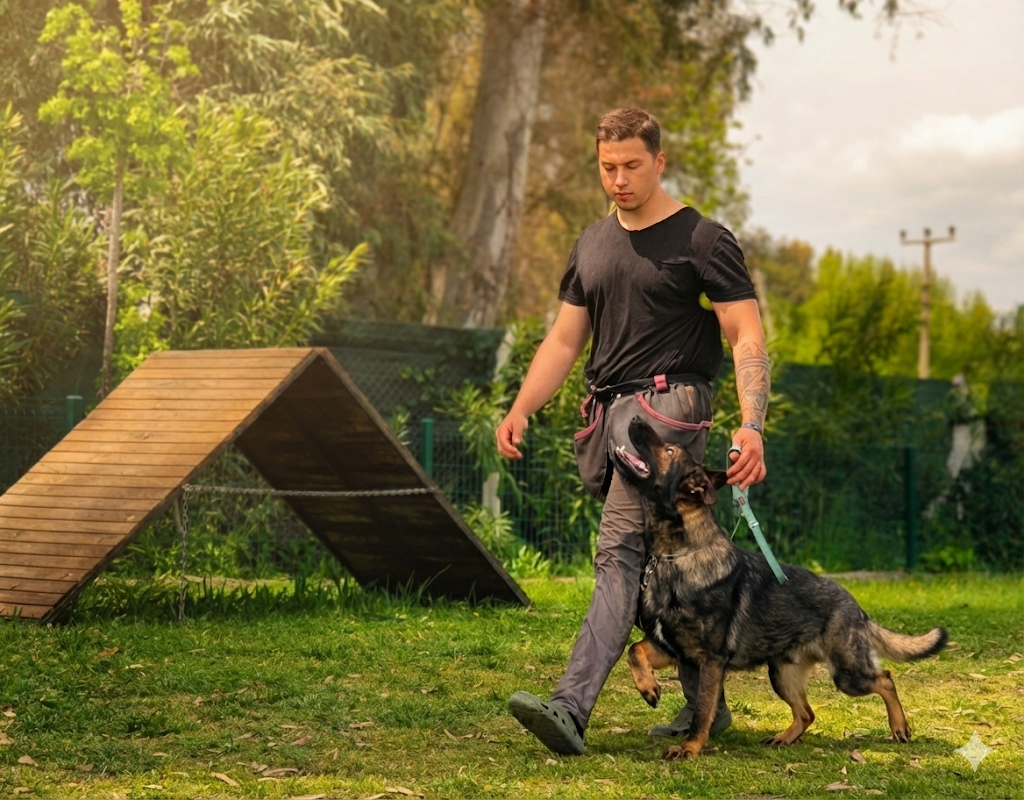
TRAINING PROGRAMS

TRAINING TAILORED TO YOU AND YOUR DOG.

A command performed at home is a beginning. The goal is communication that remains available during walks, in the city and around distractions.

TRAINING PROGRAMS

01

PUPPY TRAINING

A solid start prevents a lot of problems later.

Puppy training is more than a handful of commands. Everything from house routines to meeting the outside world, from learning to be alone to building real communication with you, gets shaped in this window.

Early socialisation matters here, but it isn't about throwing a puppy into random people and dogs. The goal is controlled, positive exposure to different environments, surfaces, sounds and situations.

What the program covers

Toilet training and house routine

Building the right toilet habits, home boundaries and a daily rhythm.

Name, focus and communication

Teaching the puppy to check in with you and building the basic communication system training runs on.

Foundation cues

Sit, down, stay, come — the behaviours that actually get used every day.

Meeting the leash and early walks

Getting comfortable with the leash, following the owner, and the basics of walking without pulling.

Socialisation

Controlled exposure to different people, dogs, surfaces, sounds and everyday triggers.

Being alone and settling

Learning to rest in its own space without constant attention, and preparing for short periods alone.

Play, mouthing and impulse control

Managing puppy biting, setting boundaries during play and teaching the right kind of play.

Owner coaching

How to keep the training going at home — rewards, boundaries and building the right daily routine.

02

BASIC & ADVANCED OBEDIENCE

More than knowing commands: reliable control in daily life.

Obedience training isn't about a dog that only performs in a training environment. The goal is a dog that keeps communicating with you on walks, in crowds, around other dogs and around real distractions.

This lines up with internationally recognised everyday-skills standards: loose-leash walking, moving calmly through a crowd, staying controlled around another dog, working around distractions, waiting on cue and a reliable recall.

What we work on

Focus and communication

The dog following you and responding to guidance.

Sit · Down · Stay · Come

The commands that actually get used in everyday life.

Leash control

Walking together without pulling.

Settling and calm-down work

Staying in a given spot and managing the need to constantly move.

Everyday house rules

Control around doors, cars, food, guests and walks.

Impulse control

Waiting for guidance instead of going straight for what it wants.

Distance sit / down / stay

Keeping basic commands reliable as distance increases.

Control around distraction

Staying focused on you in crowds, in the city and around other dogs.

This program isn't finished once the dog learns the behaviours — it's finished when those behaviours hold up at distance, over time and around real distractions. Every dog moves at its own pace; the level is set by the dog, not the calendar.

03

BEHAVIOURAL TRAINING

Not every behaviour has the same cause.

Barking, fear, reactivity or a control problem can look similar from the outside, but the cause and the conditions behind each one are different for every dog. That's why behavioural work always starts with assessing the dog and the environment it actually lives in.

What we work on

Reactivity toward people or dogs
Leash reactivity
Fear and insecurity
Excessive barking
Resource guarding
Overarousal and impulsivity
Separation-related behaviours
Difficulty adjusting to new places, people or dogs
1
Assessment

Looking at when, where and under what conditions the behaviour actually shows up.

2
Management

Adjusting the daily conditions that keep triggering the same problem.

3
Training

Teaching the dog a more manageable alternative to the current behaviour.

4
Working with the owner

Bringing the owner's follow-through into the program so the same approach continues at home.

In some serious cases of fear, anxiety or behavioural difficulty, working alongside a veterinary behaviourist may be necessary — that's a normal, professional part of this field.

04

PROTECTION TRAINING

Control matters as much as power.

Protection training isn't about making a dog uncontrollably aggressive. The goal is a dog with the right character and drive that can work in a controlled, balanced and manageable way, entirely under its handler's guidance.

Not every dog is suited to this work. Before starting, I assess the dog's character, confidence, environmental stability, response under stress and current obedience level.

How the program is structured

Suitability and character assessment

Evaluating the dog's character, confidence and drive before any protection work begins.

Obedience and handler control

Making sure the daily and advanced obedience foundation is solid before protection work starts.

Environmental stability

The dog should not develop uncontrolled behaviour toward people, other animals or everyday triggers.

Controlled protection work

Work progresses gradually, matched to the dog's character and level.

Release and regaining control

How the dog disengages on command matters as much as how it engages — this is a core part of the assessment.

Scenario and advanced work

Reserved for dogs that have reached the right foundation, planned around the specific goal.

Protection training isn't right for every dog. Every dog is assessed individually before being accepted into the program.

FREQUENT QUESTIONS

WHAT TO KNOW BEFORE YOU BEGIN.

How young can training begin?+

Age-appropriate play, toilet routines, boundaries and focus can begin as soon as a puppy arrives home. Starting early does not mean training harshly.

Why does my dog listen at home but not outside?+

Home is predictable. Outside there are smells, traffic, people and animals. Skills need to be rebuilt gradually around controlled levels of distraction.

Does only the trainer train the dog?+

No. The dog lives with the owner. Lasting progress requires the owner to learn timing, leash handling and how to practise between sessions.

How many sessions will guarantee a result?+

History, age, the severity of the issue and practice at home all change the timeline. Giving an exact guarantee before assessing the dog would not be honest.

Do you use the same method on every dog?+

No. The same behaviour can show up in two different dogs for two different reasons. I only decide on a method and pace after looking at the dog's character, motivation, history and body language.

What does on-location training actually mean?+

One-to-one work done where the dog lives its daily life — at home, in the garden, on the street, along your usual walking route. That way we're working on the real problems you deal with, not just what shows up in a controlled training environment.

My dog pulls hard on the leash. Can that be fixed?+

Yes. First I look at why: over-excitement, focus on the environment, the wrong equipment, or a habit rehearsed for years. The goal isn't holding the dog back for the whole walk — it's teaching you both to move together on a loose leash.

Do you work with fearful or traumatised dogs?+

Yes. With a fearful dog, the goal is never forcing it toward what scares it. Safe distance, correct timing and controlled exposure let the dog rebuild trust — this takes patience and consistent follow-through.

Can an older dog still be trained?+

Yes. Learning isn't only for puppies. Adult and senior dogs can absolutely pick up new behaviour, though changing a long-standing habit usually takes more repetition and consistency.

What happens after training officially ends?+

The work from sessions has to keep going at home, on walks and in daily life. Training isn't finished the moment a dog learns a few commands — regular repetition and consistent guidance are what make it stick.

How long does a training programme take?+

The duration depends on the dog's age, character, history, the problem being addressed and the owner's expectations. There is no fixed number of sessions or standard timeline that applies to every dog. After an initial assessment, we build a realistic programme together based on the dog's needs and your goals.

TELL ME A LITTLE ABOUT YOUR DOG. LET'S DISCUSS WHERE TO START.

Message on WhatsApp